« Voici quarante ans, monsieur,
que nous remplaçons le destin. »
Balzac, Cousin Bette. La cousine Bette.
A text of Jean-Jacques Didier, Doctor in Philosophy and Letters, UC Louvain (with his authorization)
This novel seems to offer us a fairy tale. Once upon a time there was a palace of dreams (Tabir sarrail, in turkish). A palace where one dreams? At the very least, a creative workshop that gives free rein to the unconscious, or an opium den where one drifts away in complete innocence? In any case, an optimistic title, to counterbalance Broken April, The General of the Dead Army, The Fall of the Stone City, The Traitor’s Niche, Stormy Weather on Mount Olympus. Kadare, a storyteller for children—or for the big kids we have remained?!
However sky-blue its dome may be, the palace is neither a studio nor a opium den, but a state-run charade. An administration, an office. The palace is an enterprise of total, totalitarian surveillance, tasked with probing all subjects of the Empire right down into their unconscious, their repressed thoughts, that which is elusive even to themselves. And dreams enter it only as raw material from which, after purification and amputation, an intelligence product (one of those capitalised words so dear to dictatorships) is to be produced every Friday – the holy day.
The organisational chart
Here is the organisational chart of this police force. At the bottom of the hierarchy, which comprises ten levels, are the ‘dreamers’ (1). All citizens of the Empire are required to report their dreams to the copyists in their town or village, who are junior civil servants (2). Couriers travel back and forth to deliver this spoils to the Palace Reception (3). The Selection Department (4) assesses whether dreams are invalid or valid; if valid, the clerk suggests a category under which to classify them.
Those that were selected were categorised into several groups, according to the types of issues involved: the security of the Empire (conspiracies, acts of treason, revolts); domestic policy (above all, the integrity of the Empire); foreign policy (alliances, wars); civil life (excesses, abuses, cases of corruption); indications of a potential Dream Master; miscellaneous[1].
Hesitation is permitted. Certified dreams and those still under consideration are forwarded to the Interpretation Department (5), which is responsible for extracting their meaning; the sub-department for Difficult Interpretations (5b) may intervene if necessary. It is essential to take this seriously, as the Verification Office (6) may launch a surprise inspection at any time and at any level of the palace. The dreamer himself, if his complex dream gives rise to controversy, is taken from his humble home and brought to the capital to undergo questioning by the Chamber of Secrecy (7). At the very top of the pyramid stand the Directorate-General and its deputy directors (8). The Master-Dreamer’s department (9) then selects the champion of dreams, who is supposed to shed light on the Empire’s future, and who is brought before the Sultan every Friday. Finally, once analysed and packaged, all the dreams are deposited in the Archives (10).
It may seem strange that this pyramid, so carefully constructed, does not include a Translation Department, given that this Empire encompasses dozens of peoples. Is this role assigned to the copyists, or is the Selection process divided into linguistic categories? The tale does not say, nor does it reveal the captain’s age.
The space (the labyrinth)
The complexity of the organisational chart is mirrored by the very physical complexity of the building itself. With hundreds of rooms spread across several underground and above-ground floors, its galleries and staircases are monumental. The doors, of imposing dimensions, are all identical. There are no signs, no directional indicators, no plaques.
The galleries seemed to him by turns familiar and unfamiliar. He could not even hear the slightest sound of a door opening. He turned onto a wide staircase and went up to the next floor, then came back down to where he had started, and, a few moments later, found himself a floor further down. Everywhere, the same silence, the same emptiness.
The labyrinth seemed to be closing in on him.
It took him nearly half an hour to finally reach the palace’s basement. […]. He thought he heard footsteps not far from him and quickened his pace to catch up with the stranger, but the other person’s footsteps also quickened. He stopped; the other person did the same. He then realised that those footsteps were his own. […] Now he had the impression that this gallery was circular in shape.. […]At times, he still thought he could hear distant footsteps, but these might just as easily have been the echo of the echo of his own footsteps, or the footsteps of people walking on other floors .[2].
The reader enjoys a bird’s-eye view that the main character—whom we have just accompanied on his wanderings—does not have. (Nepunesi i pallatit te endrrave, Employee at the Palace of Dreams’), ‘), one hesitates to describe Mark-Alem as a hero, given that he acts as a passive witness, recruited by the Selection Service and utterly baffled by the drama unfolding around him. Nor will he understand his own promotion to the rank of deputy director in the wake of the tragedy that will befall his family. This ‘witness’ unwittingly takes on the role of the token blind man, like a suburban Oedipus.
Unease on the outside
Right from the start of the novel, Mark-Alem appears hesitant. Doubt and anxiety punctuate his personal and professional life. The unease he feels as a civil servant at the palace is already evident in his fundamental difficulty in finding his footing in everyday life. The questions he leaves unanswered, his contradictory actions and errors of judgement multiply. There are countless instances of but that show him ready to act or pass judgement, only to immediately do or think the opposite. He finds it very difficult to concentrate. Headaches and eye strain are a regular occurrence for him. Space and time are by turns stretched and contracted.
[…] Then something happened that struck him as truly terrifying […] the sullen-faced civil servant, whilst continuing to read, had slowly risen from his seat. His upward movement was so slow, so steady, that Mark-Alem was seized with dread precisely because of that slowness, that steadiness […]. He was on the point of shouting: ‘Enough! I don’t want this job any more; give me back my letter […] but the official was now standing fully upright [3].
The atmosphere of the palace intensifies the sense of unreality he experiences in everyday life. But is it not for these very reasons that his mother wanted him to take up this post? To shield her fragile child from the vicissitudes of reality?
The Tabir seemed to her to be the only institution capable of ensuring her son’s salvation. Apart from the fact that this organisation offered unlimited career prospects, the key advantage she saw in it lay in its vague and hazy nature. Within this organisation, reality split in two; one quickly entered the realm of the unreal, and this fog seemed to her to be the element best suited to serve as a refuge for her son when storms were to break out.[4].
The enigmatic phrase ‘You’re right for us[5] » uttered twice to Mark-Alem as the sole justification for his recruitment, corroborates her maternal intuition. No doubt the reason his employers, for their part, see in him lies in his submissiveness and malleability, rather than in his influential family or his abilities. We shall therefore follow him as he remains constantly shy, fearful, obedient and inquisitive, ceaselessly seeking reassurance even if it means detaching himself from reality.
What on earth had happened to life, to people, to everything here on earth? Over there […] in his files, everything was so different, so beautiful, so full of fantasy […] CHow chained, miserly and tedious this world seemed compared to the other one he served! […] […] […] […] He had certainly done the right thing these past few months by not going out and seeing anyone [6].
When Mark-Alem leaves the palace in the evening, he finds it increasingly difficult to re-establish his bearings: his consciousness is so engulfed that it is the reality of the outside world (the streets, the people) that seems ever more strange to him. There is a reversal of the dream/reality poles.
Unease within
Whatever he may say, he is not always at ease there. The palace is a tightly closed system (“not openness, but isolation[7] » his boss warns him).
At the Archives, Mark-Alem is once again overcome by a sense of unease (numb fingers […] a violent throbbing in his head […] Flies were flitting before his eyes[8]… What was this drowsiness that was creeping into every limb? […] What if he were to collapse and fall asleep in these deserted corridors ?[9])
The underground world of the Archives might well hold its prey captive, just as Dante’s Hell holds its damned, or the three-arched bridge holds its walled-in prisoner[10].
"If the Tabir Sarrail is like sleep in relation to real life, continued the archivist, pushing open a door, the Archives are like an even deeper sleep within the sleep of the Tabir"[11] »
For this is indeed the so-called eternal sleep, from which one never awakens, and it will take the very real death of other men to break the enchantment—in other words, the spell. His return to reality is hinted at in the very last lines, though not without leaving a perilous future hanging in the air.
Mark-Alem’s truly ‘infernal’ task, then, consists of caging clouds. Therein lies the madness of the palace, as much as its very reason for existing, beyond all logic, above all reality. It is a matter of ‘de-dreaming’ dreams, of translating the three or four dimensions of a dream into the single linear dimension of a police report, of turning erotic fantasies into procedural records, without consulting the dreamer, but through the soliloquy of a civil servant[12] ; a comically absurd situation [13] were it not so deadly: the only time the dreamer is asked to comment on their dream is in the medieval form of the inquisition, from which one does not emerge alive.
[This institution] would be absurd in a logical world [said Kurt]. In our world as it is, however, I find it perfectly normal ![14] !
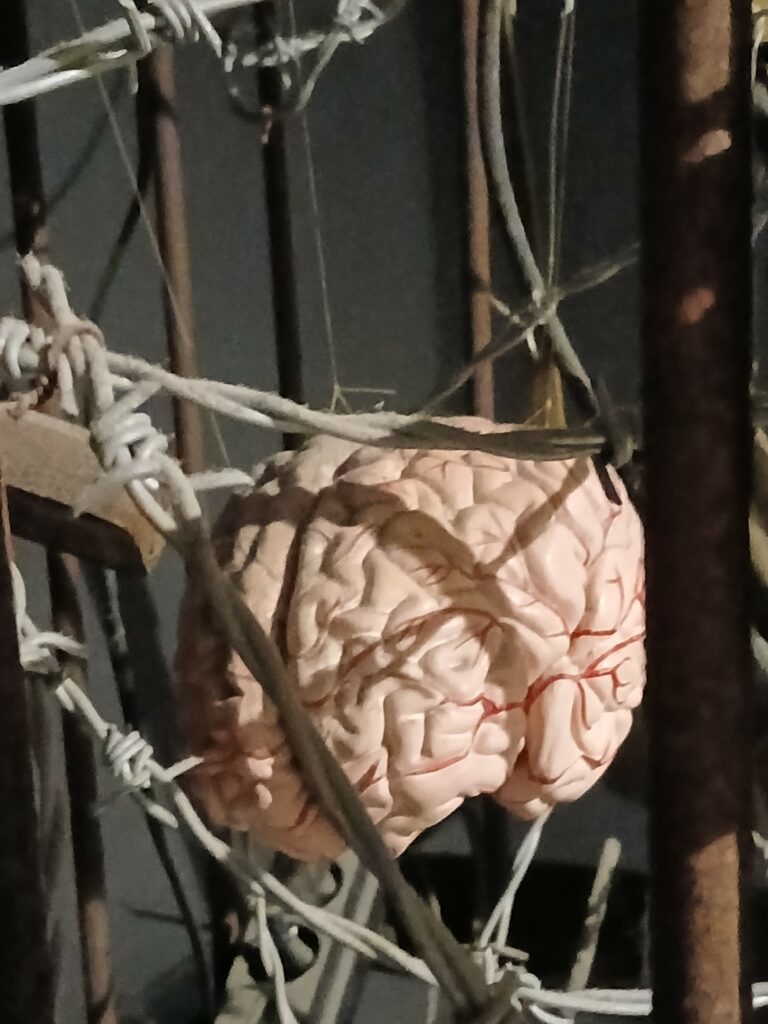
The palace’s labyrinth mimics the convolutions of the brain, but its complexity is merely a crude imitation.
The palace therefore claims to make dreams foretell the future, even if it means turning the process on its head: fabricating dreams that will say whatever those in power have agreed they should say, for ‘only the one who knows, the initiate, the one admitted to the mysteries, can truly see[15] ». Dream and reality: which invents the other?
It was therefore said that certain Dream Masters were impostors, that they were fabricated at the Tabir Sarrail by the employees themselves, according to the interests of the powerful rival factions in power, or according to the Sovereign’s whim.[16].
Tragedy and the Tragic
Magic and oracles run through the novel. One notes the significance of sight and blindness:
- La vieille gouvernante de Mark-Alem lit dans le marc de café ;
- A group of blind men frequent the café where Mark-Alem goes; they are not blind from birth, but « l‘their eyes, unlike those of ordinary mortals, had an evil gaze …] the great Ottoman State, to defend itself and protect the rest of its subjects, had decreed by special edict that these individuals should have their eyes gouged out[17] » ;
- Dans la chanson de geste qui célèbre les Quprili, un homme provoque en duel son ennemi mort. Là encore, un chevalier, aveuglé par sa propre mère, erre dans la montagne, monté sur un cheval lui aussi aveugle ;
- - The director of Mark-Alem refers to the Oracle of Delphi and the ancient palmists, who laid the foundations (albeit modest ones, he says) for the work carried out by Tabir Sarrail, who, under the name of Yildis Sarrail, initially devoted his work to the observation of the stars.
Chosen and dissected, the Master of Dreams sets the tragedy in motion. The ultimate form of denunciation [18] , though unwitting, wipes out everything around him. The only sign of rebellion is widespread insomnia: the sleep strike chosen by the Albanians, a tiny people within the Empire. Without sleep, there are no dreams. Without dreams, there is nothing left for the palace to work with. But this event is merely anecdotal.
As for the fate of the Quprili family, it is discernible from the very first pages to the attentive reader, but not to Mark-Alem. He learns that his surname derives from the Albanian word for a bridge[19]. One of the first dream accounts he reads takes place precisely at the foot of a bridge:
A derelict plot of land at the foot of a bridge; […] Amongst the rubbish […], an old musical instrument of an unusual appearance, which was playing of its own accord in this deserted expanse, and a bull, apparently driven into a frenzy by these sounds, which was bellowing at the foot of the bridge…[20]
He makes no sense of it, tosses it into the pile of worthless dreams, then picks it up again, rereads it and files it away, marked with a question mark, leaving it to Interpretation to decide.
Quickly promoted to the role of interpreter, he was the one left to grapple with the report, unable, of course, to make head or tail of it, even though for a moment he wondered whether it might be linked to his surname. ‘A meaningless dream,’ he finally says; later, his uncle Kurt warns him that the rhapsodes invited by the Quprilis to sing the family epic ‘will, amongst other things, sing the old ballad of the three-arched bridge, from which our family name is derived [21] ». It is only when the rhapsodist begins the fateful song that he feels a sense of foreboding: fragments of the dream come back to him, but confusedly, and in any case too late. Blind to the very end, when he should have served as his family’s unofficial guide, he was unable to spare them from their sudden downfall. Kurt will be the scapegoat so that the dynasty may survive, albeit in a diminished form. Mark-Alem finally understands the dream from the words of a better-informed colleague:
The Quprili (the bridge), through their gesture (the musical instrument), were engaging in an act of rebellion against the State (the raging bull)[22].
The reason for Kurt’s execution is precisely the epic song he had commissioned for that fateful gala evening. The dream will also have caused the deaths of the three musicians and the unfortunate author of the dream, a greengrocer who will have been subjected to torture.
The Palace of Dreams is metaphorically composed of two inverted pyramids. At the apex of one stands Mark-Alem, appointed deputy director in the wake of the tragedy, whilst at the opposite apex lies Kurt, hurled to his death. The Palace dispenses reward and punishment according to cryptic criteria. It is a methodical structure, yet one in which the roles assigned depend on a Jupiterian whim.
Not only is Kadaré’s work tragic in its plot, it also revitalises tragedy as a genre. It follows the course of an irresistible fate, that of a man to whom warnings are issued in a strange language, through even more obscure channels. Unable to interpret them, and growing ever more anxious, he nevertheless continues on his way. The approach of death is punctuated by brief respites and futile pleas (‘May God protect us !’) [23] ! ») which render it all the more relentless in the reader’s eyes, until the fateful moment arrives. Paradoxically, it is just as the long-awaited ancient chorus is about to intone the epic song in his honour that the powerful family suffers the wrath of the Ottoman Zeus.
Whilst the Turkish word saray, rendered as sarrail by the translator, does indeed mean ‘palace’, Tabir, for its part, means not ‘the dream’ but ‘the phrase’. At the conclusion of our analysis, the Tabir Sarrail is therefore the temple of the murderous Phrase, of the assassinating Oracle. We are a long way from the fairy tale [24]. .
[1] Ibid., p.42.
[2] Ibid., 122.
[3] Ibid., p. 16.
[4] Ibid., p 54-55.
[5] « You suit us… Mark-Alem had repeated this sentence to himself in his mind dozens of times, as if that might help him grasp its meaning. Yet there it was, closed off on all sides, enigmatic, polished like a smooth wall that one cannot cling to in an attempt to scale it.’ (Ibid., p.43)..
[6] Ibid., p 109.
[7] Ibid., p 18.
[8] Ibid., p.134.
[9] Ibid., p.137.
[10] This is the bridge from which the Quprili take their name: to ensure its stability, a man is said to have been walled up alive within it. Another novel by Kadaré, The Three-Arched Bridge, revisits the legend.
[11] Ibid., p.126.
[12]The critic Brumes draws a fascinating comparison with the current obsession with interpretation in our media-driven societies: ‘What is our present-day media and political society if not a perpetual hermeneutic factory? Every news item, however absurd, is deemed significant: it is subject to economic, sociological and political interpretations […]. Reality is viewed as an encrypted mass of facts within which messages and meanings reside, to be uncovered with the help of experts, whose interpretations can only lead to consensus. ’ (in Brumes, An Introduction: The Palace of Dreams, by Ismail Kadaré, [brumes.wordpress.com], 11 March 2014, accessed in July 2026).
[13] Henri Bergson defines the comic as the mechanical superimposed upon the living. Here, ‘the contrast is striking between abstruse and incoherent dreams, indecipherable by their very nature, and a maniacal administrative rationalisation, with its standards, routines and protocols’ (Brumes, op. cit.)., art. cit.).
[14] The Palace of Dreams,p.57. Kurt’s professed lucidity will prove his undoing.
[15] Brumes, art. cit.
[16] The Palace of Dreams, p.118. With these words, the vizier urges his nephew to keep his wits about him, for he senses the threat hanging over his family.
[17] Ibid., p.111.The theme of the evil eye, which is punished in this way, is explored in (1984).The Blind Firman (1984).
[18] Kadaré describes the ‘Masters of Dreams’ as ‘super-denunciations’ (quoted by Jean-Paul ChampseixIsmaïl Kadaré : une dissidence littéraire, chap.IX, « Le palais des rêves ou la maîtrise totalitaire », p.275 à 331, H. Champion, 2019, p.319). In it, the critic masterfully examines the novel’s socio-political significance.
[19] The Palace of Dreams, p.9.
[20] Ibid., 45.
[21] Ibid., p. 64.
[22] Ibid., p. 166.
[23] First expressed by Mark-Alem and then by his mother (Ibid., p.141 et 145).
[24] The name Tabir Sarrail has become very popular. It is now used by a post-rock quintet from Dijon (France) and by a climbing centre in Namur (Belgium).